'And God said to man: I have placed you in the world that you may more readily see what you are. I have made you neither an earthly nor a heavenly, neither a mortal nor an immortal being, in order that you, as your own sculptor, may carve features for yourself. You may degenerate into an animal; but by using your free will you may also be reborn as a god-like being.'
Giovanni Pico Della Mirandola, 'Oration on the Dignity of Man'
有空要读一读。
.
Monday, 17 May 2010

Prints & Drawings
Prints & Drawings, a pictorial history
Gottfried Lindemann, Translated by Gerald Onn
Phaidon Press, 1970
ISBN 0 7148 1760 0
Introduction
Graphic art has always been overshadowed by the painted picture. With its small format, its economical use of colour and its delicate techniques it is a fundamentally less spectacular art form and consequently is known only to the small group of connoisseurs who visit the collections of prints and drawings or are themselves collectors. But although it has not been easy for the general publich to gain access to this special branch of the fine arts, its importance as an independent medium has long been established. After all, the great European graphic collections were started as early as the sixteenth century. This, however, is only of incidental interest. What really matters is the fact that line drawing -- which lies at the heart of graphic art -- actually forms the basis of all artistic activity. Children's drawings, the incised drawings of the prehistoric cave dwellers, and the Greek vase paintings all testify in their different ways to the primacy of linear composition over colour. Moreover, when an artist chooses to portray reality in linear terms he takes the crucial step which leads away from nature and towards abstraction. Colour, on the other hand, has constantly induced artists to emulate nature.
It would be wrong to think that, by restricting himself to a linear technique, the artist also restricts his power of expression. Drawings alone offer immense scope. There is the delicate silver point, the pencil -- which is capable of producing a whole series of greys -- chalk, charcoal and the reed pen, whose harsh line stands in marked contrast to the smooth stroke of the ink brush. But, quite apart from drawings, we also have the various graphic media, which permit of infinite variations extending from the black and white contrast of the linoleum cut to the painterly nuances of the etching. With this wide selection at his disposal the graphic artist is extremely well equipped. And, like every other artist, he can use colour to heighten his effects.
But however hightly we may feel inclined to rate prints and drawings as a genre, we should not overlook the fact that in the course of their development they have led a decidedly chequered existence. In certain historical periods the only drawings produced were those used as sketches or studies while in others drawings were regarded as an autonomous branch of art and included a number of really great works. The copper engravings and woodcuts of the Durer period were conceived in purely artistic terms, whereas in the eighteenth and nineteenth centuries these techniques were used largely as a means of mechanical reproduction. In general we may say that linear composition reached its peak whenever it was pursued independently of painting and, conversely, that it reached its nadir whenever it became busservient to paitning. And so in this enquiry, in which we hope to trace the historical development of prints and drawings, we shall be assessing the imnportance of the graphic art of various periods with reference to paitning and the other artistic activies.
The illustrations include a number of less well known but none the less important prints, which it is hoped will now reach a wider public....
Well, well, i typed this purely for relax my figures. Published in 1970, it is now NOT interesting to me AT ALL. Maybe also because I am not a 'professional' painter, so the significance of drawings and paintings are equivalent on my mind. Besides, any painter would know drawings are important. Real interesting collectors would also keep an eye on their favourate artists' working process. Maybe only art sales are not so fond of prints and drawings.
我估计drawing和painting的区别和意义,有机会问问徐芒耀老师,他应该会回答得比较清楚。
Sunday, 16 May 2010


Saturday, 15 May 2010
Punctum
Camera Lucida, Roland Barthes, Vintage Classics
Page 43:
Very often the Punctum is a "detail, " i.e., a partial object. Hence, to give examples of punctum is, in a certain fashion, to give myself up. Here is a family of American blacks, photographed in 1926 by James Van der Zee. The studium is clear: I am sympathetically interested, as a docile cultural subject, in what the photograph has to say, for it speaks (it is a "good"photograph):

it utters respectability, family life, conformism, Sunday best, an effort of social advancement in order to assume the White Man's attributes (an effort touching by reason of its naiveté). The spectacle interests me but does not prick me. What does, strange to say, is the belt worn low by the sister (or daughter) -- the "solacing Mammy" -- whose arms are crossed behind her back like a schoolgirl, and avobe all her strapped pumps (Mary Janes -- why does this dated fashion touch me? I mean: to what date does it refer me?). This particular punctum arouses great sympathy in me, almost a kind of tenderness. Yet the punctum shows no preference for morality or good taste: the punctum can be ill-bred. William Klein has photographed children of Little Italy in New York (1954); all very touching, amusing, but what I stubbornly see are one child's bad teeth.

Kertész, in 1926, took young Tzara's portrait (with a monocle); but what I notice, by that additional vision which is in a sense the gift, the grace of the punctum , is Tazra's hand resting on the door frame: a large hand whose nails are anything but clean.

However lighting-like it may be, the punctum has, more or less potentially, a power of expansion. This power is often metonymic. There is a photograph by Kertész (1921) which shows a blind gypsy violinist being led by a boy; now what I see, by means of this "thinking eye" which makes me add something to the photograph, is the dirt road; its texture gives me the certainty of being in Central Europe; I perceive the referent (here, the photograph really transcends itself: s this not the sole proof of its art? To annihilate itself as medium, to be no longer a sign but the thing itself?), I recognize, with my whole body, the straggling villages I passed through on my longago travels in Hungary and Rumania.

There is another (less Proustian) expansion of the punctum: when, paradoxically, while remaining a "detail," it fills the whole picture. Duane Michals has photographed Andy Warhol: a provocative portrait, since Warhol hides his face behind both hands. I have no desire to comment intellectually on this game of hide-and-seek (which belongs to the Studium); since for me, Warhol hides nothing; he offers his hands to read, quite openly; and the punctum is not the gesture but the slightly repellent substance of those spatulate nails, at once soft and hard-edged.

extra viewing:
butdoesitfloat on André Kertész
Friday, 14 May 2010
Realism claims "truthfulness"?
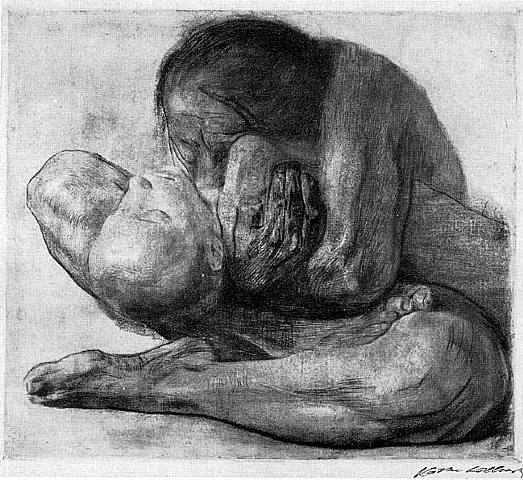
The graphic work of Kathe Kollwitz (1867-1945), who lived in the poorer districts of northern Berlin, exemplifies an approach which combines the emotional charge of German Expressionism with sober social realist concerns. Her Mother with Dead Child shows its subject without a context; there are no narrative details of the kind which Wallis included to explain the death of his stonebreaker.

But as a printmaker, she was able to specify a meaning for some of her pictures by adding a caption or slogan and using them as posters on behalf of the socialist and pacifist causes she espoused. This technique enabled her work to move from the gallery walls, to the pages of left-wing newspapers and the walls of the street. Her style combined the direct message-bearing capacity of graphic design with a psychological internsity which made her subjects more than just stereotypical victims. The theme of the mother and dead child obsessed Kollwitz as a private fear which was tragically realized in the death of her son in the First World War and of her grandson in the Second. Her strategy of infusing social realism with emotive themes became a widespread approach in left-wing art. But does this persuasive intention compromise realism's claim to "truthfulness?"
This question is particularly problematic where realist approaches intersect with the techniques of social documentary. The American photographer Lewis Hine (1874-1940) was an influential figure in the development of documentary photography. Hine worked as a campaigner for The National Child Labor Committee between 1906 and 1918 and within the wider Progressive Reform Movement. This was not a revolutionary movement, but one which sought the improvement of working-class conditions through legal reform. Hine's practice combined propaganda with social anthropology, taking pictures as part of a project to collect information and statistics on poverty, and as he put it, for "publicity in our appeal for public sympathy." His own sympathy for the people, espeicially the working children he photographed, is not in doubt, but recent attention to the ethical implications of photography has raised questions about the ideological assumptions and functions which underpin his work.

His Family in Tenement, New York City is typical of the studies he made of poor housing conditions as part of the Reform Movement's campaign to extend the bureaucratic basis of welfare provision. Through this photograph the spectator is brought like a visitor to the family. Most of the children look back with faces which variously suggest curiosity, anticipation, or indifference, and the mother's expression has an air of hospitality which removes any sense of intrusion or voyeurism. The family remains anonymous in the title, though, and despite the naturalness of the image, it is being shown as a sociological example. The room, the household objects in it, and the children's clothing are inspected as evidence of the family's economic and social status. There are no signs here of extreme poverty, so what is it that makes this family an object of the viewer's concert? Studies of Hine's work have pointed out how often he showed such families without a father present, using the absence of a male provider to signal the family's lack or neediness. The positioning of the spectator/photographer as filling this gap underscores the paternalistic impulse of the Reformist ideology, which tended to regard social reform within a Christian framework of father's care and authority. Hine's work underlines the problem for socially concerned documentary: that in depicting the poor for philanthropic purposes, such images require their subjects to conform visually with the expected styles of "being poor." His photographs also show that realism can never be truly objective because all images are contrived; mediated through the process of representation.
Propaganda and Art, by Toby Clark
Page22-24.
Toby Clark 寫得真好。也或許只是我,他的文字看來比較順暢。不像法國人的那麼抒情。哈哈。
Subscribe to:
Posts (Atom)