Showing posts with label truth. Show all posts

Friday, 14 May 2010

Realism claims "truthfulness"?


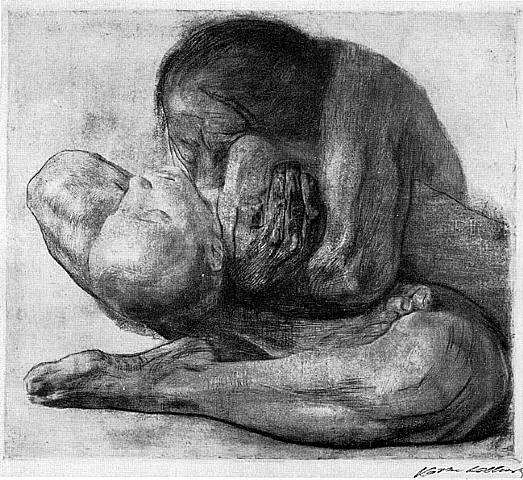
The graphic work of Kathe Kollwitz (1867-1945), who lived in the poorer districts of northern Berlin, exemplifies an approach which combines the emotional charge of German Expressionism with sober social realist concerns. Her Mother with Dead Child shows its subject without a context; there are no narrative details of the kind which Wallis included to explain the death of his stonebreaker.

But as a printmaker, she was able to specify a meaning for some of her pictures by adding a caption or slogan and using them as posters on behalf of the socialist and pacifist causes she espoused. This technique enabled her work to move from the gallery walls, to the pages of left-wing newspapers and the walls of the street. Her style combined the direct message-bearing capacity of graphic design with a psychological internsity which made her subjects more than just stereotypical victims. The theme of the mother and dead child obsessed Kollwitz as a private fear which was tragically realized in the death of her son in the First World War and of her grandson in the Second. Her strategy of infusing social realism with emotive themes became a widespread approach in left-wing art. But does this persuasive intention compromise realism's claim to "truthfulness?"

This question is particularly problematic where realist approaches intersect with the techniques of social documentary. The American photographer Lewis Hine (1874-1940) was an influential figure in the development of documentary photography. Hine worked as a campaigner for The National Child Labor Committee between 1906 and 1918 and within the wider Progressive Reform Movement. This was not a revolutionary movement, but one which sought the improvement of working-class conditions through legal reform. Hine's practice combined propaganda with social anthropology, taking pictures as part of a project to collect information and statistics on poverty, and as he put it, for "publicity in our appeal for public sympathy." His own sympathy for the people, espeicially the working children he photographed, is not in doubt, but recent attention to the ethical implications of photography has raised questions about the ideological assumptions and functions which underpin his work.

His Family in Tenement, New York City is typical of the studies he made of poor housing conditions as part of the Reform Movement's campaign to extend the bureaucratic basis of welfare provision. Through this photograph the spectator is brought like a visitor to the family. Most of the children look back with faces which variously suggest curiosity, anticipation, or indifference, and the mother's expression has an air of hospitality which removes any sense of intrusion or voyeurism. The family remains anonymous in the title, though, and despite the naturalness of the image, it is being shown as a sociological example. The room, the household objects in it, and the children's clothing are inspected as evidence of the family's economic and social status. There are no signs here of extreme poverty, so what is it that makes this family an object of the viewer's concert? Studies of Hine's work have pointed out how often he showed such families without a father present, using the absence of a male provider to signal the family's lack or neediness. The positioning of the spectator/photographer as filling this gap underscores the paternalistic impulse of the Reformist ideology, which tended to regard social reform within a Christian framework of father's care and authority. Hine's work underlines the problem for socially concerned documentary: that in depicting the poor for philanthropic purposes, such images require their subjects to conform visually with the expected styles of "being poor." His photographs also show that realism can never be truly objective because all images are contrived; mediated through the process of representation.


Propaganda and Art, by Toby Clark
Page22-24.

Toby Clark 寫得真好。也或許只是我,他的文字看來比較順暢。不像法國人的那麼抒情。哈哈。

Monday, 10 May 2010

the Winter Garden Photograph

Camera Lucida, Roland Barthes, Vintage Classics
Page 67:

28.

There I was, alone in the apartment where she had died, looking at these pictures of my mother, one by one, under the lamp, gradually moving back in time with her, looking for the truth of the face I had loved. And I found it.

The photograph was very old. The corners were blunted from having been pasted into an album, the sepia print had faded, and the picture just managed to show two children standing together at the end of a little wooden bridge in a glassed-in conservatory, what was called a Winter Garden in those days. My mother was five at the time (1898), her brother seven. He was leaning against the bridge railing, along which he had extended one arm; she, shorter than he, was standing a little back, facing the camera; you could tell that the photographer had said, "Step forward a little so we can see you"; she was holding one finger in the other hand, as children often do, in an awkward gesture. The brother and sister, united, as I knew, by the discord of their parents, who were soon to divorce, had posed side by side, alone, under the palms of the Winter Garden (it was the house where my mother was born, in Chennevieres-sur-Marne).

I studied the little girl and at last rediscovered my mother. The distinctness of her face, the naive attitude of her hands, the place she had docilely taken without either showing or hiding her, like Good from Evil, from the hysterical little girl, from the simpering doll who plays at being a grownup -- all this constituted the figure of a sovereign innocence (if you will take this word according to its etymology, which is:"I do no harm"),all this had transformed the photographic pose into that untenable paradox which she had nonetheless maintained all her life: the assertion of a gentleness. In this little girl's image I saw the kindness which had formed her being immediately and forever, without her having inherited it from anyone; how could this kindness have proceeded from the imperfect parents who had loved her so badly--in short: from a family? Her kindness was specifically out-of-play, it belonged to no system, or at least it was located at the limits of a morality (evangelical, for instance); I could not define it better than by this feature (among others): that during the whole of our life together, she never made a single "observation." This extreme and particular circumstance, so abstract in relation to an image, was nonetheless present in the face revealed in the photograph I had just discovered. "Not a just image, just an image," Godard says. But my grief wanted a just image, an image which would be both justice and accuracy - justesse: just an image, but a just image. Such, for me, was the Winter Garden Photograph.

For once, photography gave me a sentiment as certain as remembrance, just as Proust experienced in one day when, leaning over to take off his boots, there suddenly came to him his grandmother's true face, "whose living reality I was experiencing for the first time, in an involuntary and complete memory." The unknown photographer of Chennevieres-sur-Marne had been the mediator of a truth, as much as Nadar making of his mother (or of his wife - no one knows for certain) one of the loveliest photograph in the world; he had produced a supererogatory photograph which contained more than what the technical being of photography can reasonably offer. Or again (for I am trying to express this truth) this Winter Garden Photograph was for me like the last music Schumann wrote before collapsing, that first Gesang der Fruehe which accords with both my mother's being and my grief at her death, I could not express this accord except by an infinite series of adjectives, which I omit, convinced however that this photograph collected all the possible predicates from which my mother's being was constituted and whose suppression or partial alteration, conversely, had sent me back to these photographs of her which had left me so unsatisfied. These same photographs, which phenomenology would call "ordinary" objects, were merely analogical, provoking only her identity, not her truth; but the Winter Garden Photograph was indeed essential, it achieved for me, utopically, the impossible science of the unique being.


好一个感伤的巴特。我发现一个用感觉多过术语来写作的人,要向巴特先生学习如何热情地推销自创的词汇。
就像那些涂鸦的年轻人一样。还要准备古典音乐,培养高尚的感情。
bonus -- 原来Nadar有很多轶事。他是最早用人造光拍照的摄影师,他把自己的工作室借给印象派画家使用,促成第一届印象主义画展,他还是最早作高空摄影的人。了不起,了不起。